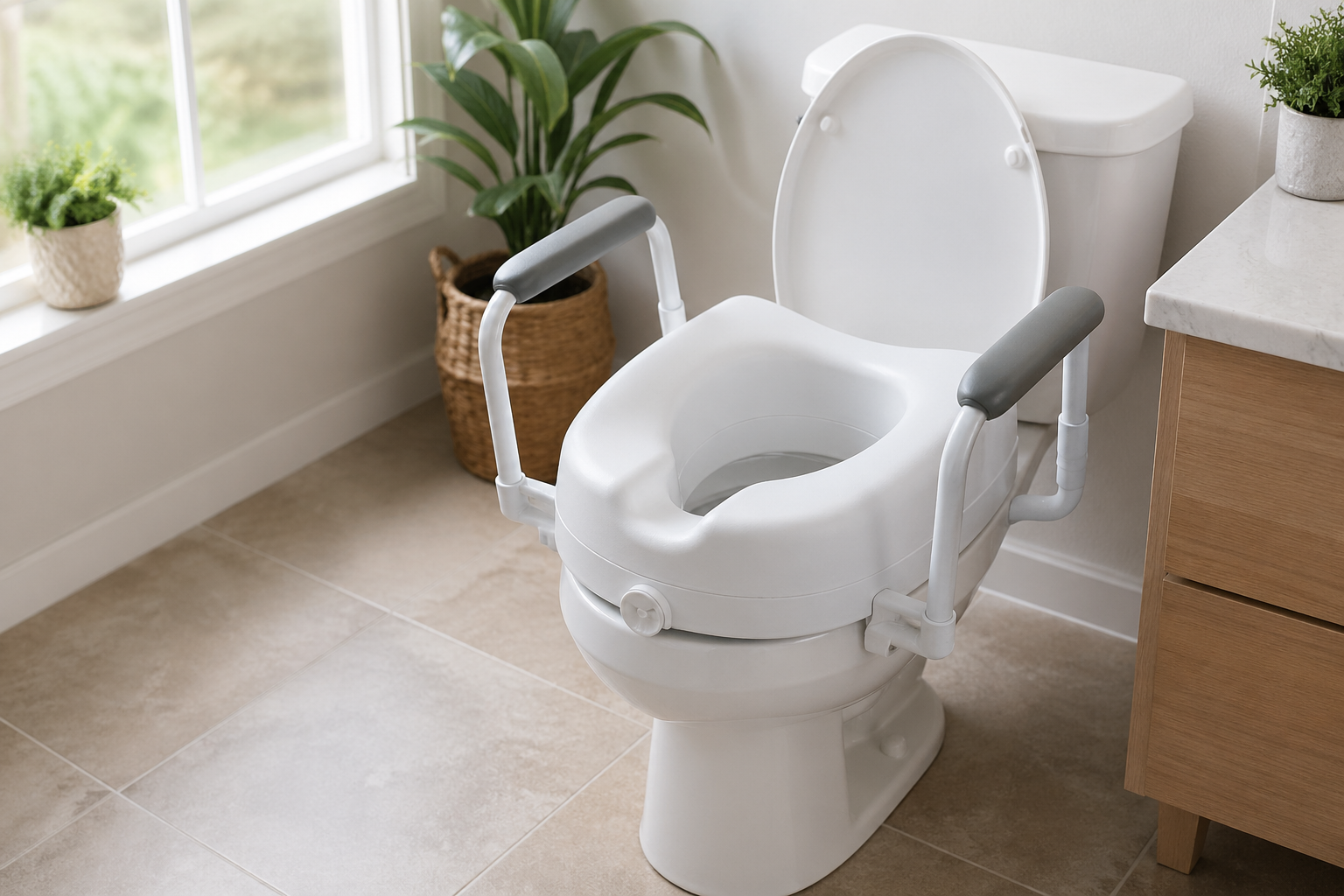
Using the bathroom becomes unexpectedly difficult for seniors with arthritis, hip replacements, knee pain, or general mobility limitations. The low height of standard toilets requires deep bending and significant leg strength to sit down and stand up, creating pain, fall risk, and often the need for caregiver assistance. For individuals with arthritis affecting the hips, knees, or lower back, this fundamental daily activity can become a source of anxiety and loss of independence.
The best raised toilet seats with arms provide both elevation that reduces bending distance and supportive armrests that offer stable grip points for lowering and rising. These bathroom safety devices allow individuals with arthritis, joint replacements, balance impairments, or general weakness to use the toilet independently without requiring assistance from family members or caregivers. The best raised toilet seats with arms for seniors with arthritis combine appropriate height elevation with sturdy armrest construction and secure attachment methods that prevent shifting during use.
Raised toilet seats with arms work alongside other bathroom safety equipment, like shower chairs and grab bars, to create comprehensive accessibility in the most critical room of the home. For seniors managing arthritis, these devices often complement bedroom safety aids like bed rails that address similar sitting-to-standing challenges throughout the day.
For seniors maintaining independent living, caregivers managing bathroom safety, and individuals recovering from surgery or managing chronic conditions, choosing the right raised toilet seat means evaluating factors like seat height, armrest positioning, weight capacity, and installation method. These products serve not only those with diagnosed arthritis but also anyone experiencing age-related mobility decline, recovering from hip or knee replacement, managing balance disorders, or dealing with conditions that make standard toilet height challenging.
This guide examines top-rated raised toilet seats with arms, focusing on products specifically beneficial for seniors with arthritis and limited mobility. Each recommendation includes details on height elevation, armrest design, attachment security, and who benefits most from specific construction characteristics.
Table of Contents
As an Amazon Associate, we may earn a commission from qualifying purchases at no additional cost to you.
Best Raised Toilet Seats with Arms for Seniors with Arthritis
1. Vive Raised Toilet Seat with Arms – 5 Inch Height with Padded Armrests

The Vive Raised Toilet Seat features a 5-inch elevation with wide, padded armrests that provide comfortable support during sitting and standing transitions. This combination of substantial height increase and cushioned arm support addresses both the bending limitation and the need for stable grip points that characterize arthritis-related bathroom challenges. The padded armrests reduce pressure on arthritic hands and wrists during weight-bearing, making the transfer process less painful than using hard plastic or metal rails.
As one of the best raised toilet seats with arms, this product works exceptionally well for individuals with moderate to severe arthritis affecting hips, knees, or lower back who need significant height assistance but whose primary pain concern is hand and wrist joints during gripping. The cushioned armrests allow users to bear weight through their forearms if gripping causes excessive pain, distributing force across a larger surface area. This forearm-bearing approach benefits the same individuals who use ergonomic key turners and button hooks to reduce hand strain during other daily tasks. The 5-inch elevation is substantial enough to serve most users recovering from hip or knee replacement or those with a limited range of motion.
The seat width accommodates users up to 300 pounds and features a contoured design that provides comfortable seating during use. The armrests are positioned at optimal height and distance to provide leverage without requiring users to reach excessively or sit in uncomfortable positions. The armrests are removable, which serves households where some individuals need arm support while others prefer unobstructed access or where toilet positioning requires one-sided arm removal.
The installation uses a secure locking mechanism that attaches the seat directly to the toilet bowl without tools. The locking tabs engage the bowl rim and tighten with hand-operated adjusters, creating a stable connection that prevents shifting during transfers. The system works with most standard elongated and round toilets, accommodating the majority of residential bathroom fixtures. The attachment takes approximately 5 minutes and requires no special skills or strength.
The seat surface includes a splash guard that prevents liquid from escaping the front, maintaining hygiene and reducing cleanup. The surface is smooth and non-porous, cleaning easily with standard bathroom cleaners and resisting staining or odor absorption. The white finish coordinates with most toilet colors, maintaining bathroom aesthetics better than medical-looking equipment in institutional colors.
The armrests extend from the front to the back of the seat, providing continuous support throughout the entire transfer process. This extended coverage benefits users who need to shift hand positions during lowering or rising due to pain or weakness. For seniors with arthritis who need both significant height elevation and cushioned arm support that protects painful joints, this padded design provides comprehensive assistance in a single device.
2. Drive Medical Raised Toilet Seat with Removable Arms

The Drive Medical Raised Toilet Seat offers a 5-inch elevation with removable padded arms that can be taken off independently on either side, providing configuration flexibility for different bathroom layouts and user needs. This removability serves bathrooms where toilet positioning against walls or next to fixtures prevents bilateral arm installation, households with multiple users who have varying support needs, or situations where arms need removal for thorough cleaning or temporary accessibility changes.
This product excels for families where some members need arm support while others prefer standard toilet access, or for individuals whose capabilities vary throughout the day or across recovery stages. The ability to remove one or both arms without affecting seat stability means the configuration can adapt as the user’s strength improves or declines. The independent removal on each side accommodates bathrooms with limited side clearance where one arm would contact walls or vanities.
As one of the best raised toilet seats with arms, it features a weight capacity of 300 pounds and includes a front splash guard for hygiene. The surface is molded from durable plastic that withstands daily use without cracking or degrading, and the smooth finish resists bacterial growth and cleans easily. The contoured seat design provides comfortable support during use, with gentle shaping that reduces pressure points for individuals who may need extended seated time.
The armrests are padded with closed-cell foam that doesn’t absorb moisture and maintains its cushioning properties through repeated cleaning. The padding height is substantial enough to provide comfortable hand and forearm contact without being so thick that it compresses completely under weight. The armrests lock securely into mounting brackets that are integral to the seat structure, preventing wobbling or shifting during use.
The installation attaches to the toilet bowl using adjustable brackets that fit both round and elongated toilets. The brackets include rubberized contact points that grip the bowl surface and prevent sliding even when significant lateral force is applied during transfers. The tool-free installation uses hand-tightened knobs that create secure attachment without requiring tools that might be difficult for arthritic hands to operate.
The Drive Medical seat is particularly valuable for renters who need temporary accessibility modifications, individuals recovering from surgery who anticipate needing support for limited timeframes, or households managing bathroom access for multiple family members with different mobility levels. The removable arms provide flexibility without compromising the stability and height benefits of the raised seat. This adaptability mirrors the approach seen in adjustable walkers and power lift recliners that accommodate changing mobility needs without requiring complete equipment replacement. For seniors with arthritis who need adaptable bathroom safety equipment that grows with changing needs, this configurable design provides long-term value.
3. Carex E-Z Lock Raised Toilet Seat with Arms – 3.5 Inch Height

The Carex E-Z Lock Raised Toilet Seat features a 3.5-inch elevation with integrated armrests and a unique locking mechanism that creates exceptionally secure attachment to the toilet bowl. This lower elevation serves individuals who need modest height assistance rather than maximum lift, such as those with mild arthritis, early-stage mobility limitations, or users who are taller and whose standard toilet height is already somewhat accessible. The secure locking system addresses the common frustration of raised seats that shift or wobble during transfers.
Coming in at number three on the list of best raised toilet seats with arms, this product works particularly well for seniors with mild to moderate arthritis who primarily need stable arm support and slight height assistance rather than maximum elevation. The 3.5-inch raise is adequate for individuals who can still achieve reasonable bending but need a reduction in the depth of squat required. The armrests provide the primary safety benefit by offering secure grip points that reduce fall risk and allow controlled lowering and rising.
The E-Z Lock mechanism uses a lever system that engages the toilet bowl rim from multiple angles, creating a clamping action that prevents forward, backward, and lateral movement. This multi-point attachment is more secure than simple friction-fit designs and remains stable even when users apply significant force through the armrests. The locking lever operates with a simple up-and-down motion that requires minimal hand strength, making installation and removal accessible for seniors managing the equipment independently.
The seat supports up to 300 pounds and features armrests positioned at ergonomic height for optimal leverage during transfers. The armrests are made from textured plastic that provides grip without being so aggressive that it catches on clothing or creates discomfort during contact. The armrest width provides adequate spacing to accommodate users comfortably without making the overall width so large that it interferes with bathroom door clearance or toilet positioning.
The seat includes a front splash guard and features a smooth, easy-clean surface that maintains hygiene with minimal effort. The white plastic construction matches standard toilet colors and maintains a cleaner aesthetic than some raised seats with visible hardware or institutional appearance. The contoured seat design provides comfort during use while maintaining the structural integrity needed for safe weight bearing.
The Carex seat is particularly suitable for individuals in apartments or rental properties who need secure attachment without permanent modifications, seniors whose bathroom clearance won’t accommodate the wider profile of higher raised seats with extended armrests, or users who need reliable stability above maximum height elevation. For those with arthritis who prioritize secure attachment and arm support over dramatic height increase, this lower-profile design with superior locking provides essential safety features.
4. Medline Bariatric Raised Toilet Seat with Locking Arms – 600 lb Capacity

The Medline Bariatric Raised Toilet Seat features a heavy-duty construction rated for 600-pound weight capacity, substantially higher than standard models and among the highest available for home bathroom use. This medical-grade design serves bariatric users, individuals who need to apply significant force through the armrests during transfers, or those who require equipment that withstands above-average stress without degrading. The 4-inch elevation combined with reinforced steel-leg construction and soft foam armrests provides both height assistance and structural support for larger body frames.
This is one of the best raised toilet seats with arms for bariatric seniors with arthritis who face double challenges of joint pain and limited equipment options that accommodate their size and weight. The reinforced construction means the seat and arms don’t flex or feel unstable under weight, providing the confidence needed for independent transfers. The 14-inch-long steel legs provide exceptional stability that far exceeds plastic-leg designs, creating a solid foundation that doesn’t shift during use.
The armrests feature soft foam padding that provides comfortable contact during transfers while remaining firm enough to support significant weight-bearing. The foam material is a closed-cell construction that resists moisture absorption and maintains its cushioning properties through repeated cleaning. The armrests extend 14 inches in length, providing continuous support throughout the entire transfer process and allowing users to shift hand positions as needed during lowering or rising.
The seat is specifically designed for use on toilets with a seat height of 14 inches or less, ensuring secure and stable positioning. The locking mechanism engages the toilet bowl rim firmly, preventing the shifting and wobbling that can occur with heavy users or during transfers that involve lateral movement. The locking system requires no tools for installation and can be operated by users with limited hand strength, though the secure attachment it creates rivals bolt-down installations.
The seat surface is contoured to provide comfortable support for larger body frames, with a generous width that prevents the constrained feeling some plus-size users experience with standard toilet seats. The medical-grade plastic construction withstands frequent cleaning with strong disinfectants without degrading, and the smooth surface resists staining and odor absorption. The overall build quality reflects Medline’s focus on medical and healthcare products rather than consumer-grade equipment.
The 4-inch elevation is substantial enough to serve most bariatric users recovering from joint replacement or managing severe arthritis, though the height is one inch lower than some maximum-elevation models. This slightly lower profile can actually benefit users whose feet need to maintain better floor contact for stability during transfers. The elevation reduces bending depth significantly while keeping users’ feet planted firmly on the floor.
The Medline bariatric seat is particularly valuable for individuals who have struggled to find raised toilet seats rated for adequate weight capacity, those who need equipment that feels substantial and stable rather than flexible during use, or bariatric users recovering from joint replacement who need temporary elevation with absolute confidence in structural integrity. For plus-size seniors with arthritis who need both height assistance and arm support in equipment specifically engineered for higher weight capacity with medical-grade construction, this heavy-duty option provides appropriate safety without compromise. The 600-pound rating provides a substantial safety margin even for users approaching 400 pounds, ensuring the equipment remains stable under the dynamic forces that occur during transfers.
5. Soaids Travel Toilet Seat Riser with Handles – Portable Design for Round Toilets

The Soaids Travel Toilet Seat Riser features a lightweight, portable design optimized for seniors who travel frequently or need bathroom assistance in multiple locations. This 5-inch elevated seat with adjustable aluminum armrests installs and removes without tools in seconds, making it ideal for RV trips, hotel stays, family visits, or any temporary accommodation. The quick-release design allows users to switch between the raised seat and standard toilet configuration quickly, serving households with multiple users or situations where the seat needs temporary installation.
This product works exceptionally well for active seniors with arthritis who maintain travel schedules but need consistent bathroom accessibility regardless of location. The ability to bring familiar, properly-fitted equipment to unfamiliar bathrooms reduces anxiety about accessibility in hotels, vacation rentals, or family homes where standard toilet heights create difficulty. The lightweight construction makes carrying the seat from vehicle to destination manageable without requiring assistance.
The armrests feature adjustable width settings of either 16 or 18 inches, allowing customization for different body sizes and comfort preferences. This adjustability also helps the seat accommodate round toilets with varying bowl dimensions, ensuring a stable fit across different bathroom fixtures. The arms are made from aluminum with non-slip supportable surfaces that provide a secure grip during transfers without creating uncomfortable pressure on arthritic hands.
The option among the best raised toilet seats with arms is specifically designed for traditional-style round toilet bowls measuring 16-17 inches in depth and 14.5 inches in width. This round-specific design ensures proper fit and weight distribution on round toilets, preventing the wobbling or poor alignment that can occur when universal-fit seats are used on round bowls. The precise sizing creates stable contact around the entire bowl rim, preventing shifting during transfers.
The installation uses a fixing system on both sides that stabilizes the seat on the bowl without requiring tools or complex mechanisms. The seat simply positions on top of the toilet bowl and secures through friction and weight distribution, allowing installation in seconds by users with limited hand strength. The quick-release feature means the seat removes equally fast when bathroom access needs to return to standard configuration or when packing for return travel.
The seat is constructed from high-quality, hygienic plastic that supports up to 300 pounds and cleans easily with standard bathroom cleaners. The smooth, non-porous surface resists staining and bacterial growth, maintaining hygiene even when used in unfamiliar bathrooms. The material withstands temperature variations and exposure to different cleaning products encountered in various locations.
The compact design stores easily in car trunks, closets, or RV storage compartments when not in use. The lightweight construction, substantially lighter than floor-standing models, makes the seat manageable for seniors to carry independently from storage to the bathroom. The armrests, while providing stable support, don’t add excessive bulk that would make transport difficult.
The Soaids seat replaces the standard toilet seat and lid entirely during use, providing a complete raised seating solution rather than sitting on top of existing seats. This replacement approach creates a more stable, integrated feel compared to risers that stack on existing seats. For seniors with arthritis who travel regularly, visit family in different cities, spend time in seasonal residences, or need bathroom accessibility during medical appointments, hotel stays, or rehabilitation facility visits, this portable design provides consistent support across multiple locations without requiring permanent installation at each site. The travel-friendly construction ensures bathroom independence isn’t sacrificed due to changing locations or temporary accommodations.
6. Platinum Health Raised Toilet Seat with Arms – Extra Wide Design

The Platinum Health Raised Toilet Seat features an extra-wide seat design measuring approximately 20 inches across, providing generous accommodation for plus-size users or those who need additional lateral space for comfortable positioning. This width, combined with reinforced armrests, creates a bariatric-friendly option that doesn’t compromise on stability or support. The 5-inch elevation addresses height needs while the expanded width serves body frame requirements.
This product works exceptionally well for individuals who find standard 16-17 inch toilet seat widths constraining or uncomfortable, plus-size users with arthritis who need both elevation and appropriate dimensional accommodation, or those recovering from hip replacement who require wider seat spacing during healing. The extra width reduces pressure concentration and provides more comfortable long-term seating for users who may need extended bathroom time.
The armrests are positioned wider apart than standard models, accommodating the increased seat width while maintaining ergonomic lever positioning. The arms feature padded grips that reduce pressure on arthritic hands and wrists during weight-bearing transfers. The padding material is closed-cell foam that resists moisture absorption and maintains its shape through repeated use and cleaning.
The seat attaches using heavy-duty brackets designed to distribute the increased weight and width across the toilet bowl rim safely. The brackets include extra-wide contact surfaces that prevent stress concentration on the porcelain, and the material includes rubberized pads that grip the bowl surface securely. The installation accommodates both round and elongated toilets, though the extra width means careful measurement of bathroom clearance is important before purchase.
The seat surface is contoured to provide comfort across the wider dimension, with gentle shaping that supports without creating uncomfortable pressure lines. The plastic construction is reinforced in stress areas, and the overall build quality reflects consideration of the additional forces involved with larger users. The weight capacity is rated for 300 pounds.
The Platinum Health seat includes a front splash guard sized appropriately for the wider dimensions and features easy-clean surfaces throughout. The white finish coordinates with standard toilets, and the overall appearance maintains dignity despite the medical functionality. For plus-size seniors with arthritis who need both height elevation and dimensional accommodation that standard-width raised seats cannot provide, this extra-wide design addresses both mobility and comfort needs comprehensively.
How to Choose the Best Raised Toilet Seat with Arms
Selecting the best raised toilet seat with arms for seniors with arthritis requires understanding the individual’s specific mobility limitations, bathroom configuration, toilet type, and whether the elevation serves temporary recovery or long-term accessibility needs. Different designs serve different functional capabilities and installation situations, and matching these factors ensures the chosen product genuinely improves safety and independence.
Height Elevation Needed
Individuals recovering from hip or knee replacement typically need a 5-inch elevation as recommended by surgeons to prevent excessive joint flexion during healing. Seniors with severe arthritis or significant range-of-motion limitations also benefit from maximum elevation that reduces bending depth. Those with moderate limitations or taller stature may find a 3.5 to 4-inch elevation adequate, which creates less dramatic height change and may feel more natural during use.
Excessive elevation can create new problems, including feet not reaching the floor when seated, which affects stability and makes transfers more difficult. Measuring from the top of the current toilet seat to the user’s knee bend when standing helps determine the appropriate elevation. The best raised toilet seats with arms should position the user’s hips slightly above or level with their knees when seated. Individuals who struggle with bending during bathroom transfers often face similar challenges putting on shoes, making long-handled shoe horns another valuable accessibility tool for comprehensive independence.
Armrest Style and Positioning
Fixed armrests provide maximum stability but require adequate bathroom clearance on both sides and don’t accommodate households with multiple users who have varying needs. Removable arms offer flexibility for cleaning, different user needs, or bathrooms with limited side clearance where one arm would contact walls or fixtures. The padded arms of the best raised toilet seats with arms reduce pressure on arthritic hands and wrists, while hard plastic arms provide firmer pushing surfaces.
Armrest height and positioning affect leverage during transfers. Arms positioned too low don’t provide adequate pushing surface for standing, while arms positioned too high require uncomfortable reaching that stresses shoulder joints. The distance between arms should accommodate comfortable body positioning without feeling constrained or too wide for effective arm use.
Weight Capacity and Build Quality
Standard raised toilet seats typically support 250-300 pounds, adequate for most users. Bariatric individuals or those who apply significant force through armrests during transfers need one of the best raised toilet seats with arms rated for 350-400 pounds. The weight rating should exceed the user’s weight substantially to ensure stability under the dynamic forces that occur during transfers, which can momentarily exceed static body weight. Seniors with tremors from Parkinson’s disease or essential tremor may apply especially variable forces during transfers, just as they benefit from weighted utensils that stabilize eating through similar principles.
Build quality indicators include plastic thickness, reinforcement in stress areas, quality of attachment hardware, and how substantial the seat feels when handled. Flimsy construction flexes during use and degrades quickly, while well-built seats maintain rigidity and stability through years of daily transfers.
Toilet Type and Bathroom Configuration
Round toilets require round or universal-fit raised seats, while elongated toilets work best with elongated-specific or universal designs. Using the wrong shape creates gaps, overhangs, or poor weight distribution that affects both comfort and stability. Measuring the toilet bowl from mounting bolts to front edge determines whether it’s round (approximately 16.5 inches) or elongated (approximately 18.5 inches).
Bathroom clearance affects whether fixed bilateral arms will fit or whether one arm must be removed for door swing, wheelchair access, or other spatial constraints. Distance from toilet to side walls, tub edges, or vanities determines whether wide or standard-width seats accommodate the space. Small powder rooms may require compact designs, while larger bathrooms accommodate any configuration.
Installation Method and Security
Tool-free installations serve seniors living alone who must manage equipment independently, those in assisted living where maintenance staff may not be available for installation, or individuals who need to remove seats periodically for cleaning or temporary use. Tool-based installations typically provide a more secure attachment but require assistance or adequate hand strength for tightening bolts or screws.
Locking mechanisms that engage toilet bowl rims from multiple angles provide better security than simple friction-fit designs. Multi-point attachment prevents the shifting and wobbling that creates anxiety during transfers. Testing attachment security before full weight-bearing use is critical; the seat should not move at all when pushed forward, backward, or side-to-side.
Portability and Permanence Needs
Seniors maintaining one residence benefit from sturdy permanent installations optimized for stability over portability. Those traveling regularly, splitting time between homes, or needing equipment in multiple bathrooms benefit from lightweight portable designs easy to install and remove. Temporary recovery situations, post-surgical healing, may justify portable equipment that can be removed once healing completes, while progressive arthritis suggests permanent installation makes more sense.
Common Mistakes When Choosing Raised Toilet Seats
Many purchasers select raised toilet seats based solely on height elevation without considering whether armrests are truly necessary or whether their bathroom clearance accommodates the wider profile armrests create. A seat with arms that contact walls or prevent the door from closing creates new accessibility barriers while addressing mobility needs. Always measure bathroom clearance before purchasing seats with fixed bilateral arms.
Another frequent error is choosing universal-fit designs for elongated or round toilets without verifying the fit quality. While universal seats technically work with both bowl types, they often don’t align perfectly and can create gaps, overhangs, or wobbling. Choosing toilet-specific designs when possible provides a better fit, stability, and comfort.
Some individuals purchase the highest available elevation, assuming more is better, then discover that excessive height creates difficulty with feet reaching the floor, or standing from the higher position feels unstable. The optimal height positions the hips level with or slightly above the knees when seated, not dramatically higher. Too much elevation can be as problematic as too little.
Finally, overlooking attachment security can create serious safety hazards. Seats that shift during transfers cause falls and injury. Testing attachment thoroughly before full use and periodically checking that locking mechanisms remain tight prevents accidents caused by loosened connections. Any movement detected during testing indicates an inadequate installation that requires adjustment before use.
Another oversight is addressing bathroom accessibility in isolation without considering comprehensive mobility needs throughout the home. Seniors who need raised toilet seats typically also benefit from arthritis-friendly daily living aids, including electric can openers, no-tie shoelaces, and one-handed jar openers that address hand strength limitations across all activities of daily living.
Final Thoughts
Raised toilet seats with arms restore bathroom independence for seniors with arthritis by reducing bending depth and providing stable support during transfers. These essential bathroom safety devices address fundamental dignity and quality-of-life concerns, allowing individuals with joint pain and mobility limitations to manage personal care autonomously. The best raised toilet seats with arms for seniors with arthritis combine appropriate elevation with ergonomic armrest design, secure attachment methods, and construction quality that withstands daily use.
For caregivers and family members, selecting appropriate raised toilet seats means evaluating the senior’s specific mobility limitations, bathroom configuration, toilet type, and whether needs are temporary or long-term. Five-inch elevations serve post-surgical recovery and severe limitations, while moderate elevations address mild to moderate arthritis. Creating a fully accessible bathroom often requires combining raised toilet seats with compact shower seating, grab bars, and adequate lighting to address all aspects of bathroom safety for seniors with mobility limitations. Padded arms reduce pressure on painful joints, while heavy-duty construction accommodates bariatric users or those requiring maximum stability.
Comprehensive home accessibility extends beyond the bathroom to include bedroom safety equipment for safe bed transfers, dressing aids that reduce bending and reaching, and mobility devices that support safe movement throughout the home. Addressing toilet accessibility is an essential component of this broader strategy for aging in place.
Investing in quality raised toilet seats with arms represents a relatively modest expense that dramatically impacts daily independence, safety, and dignity. For many seniors with arthritis, the ability to use the bathroom independently without pain, fall risk, or caregiver assistance means maintaining fundamental autonomy that supports continued independent living and preserves self-respect in the most personal daily activities.
Was this article helpful? Read one of these next:


Leave a Reply